
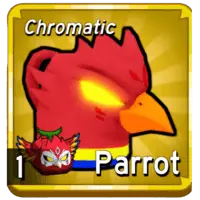
Parrot
Demand & Trend
This item trades at a stable rate. Fair trades are common.
Parrot is one of those limited fruits that can look weak if you only read one public value line and then stop there. That is exactly where the wrong trade starts. The fruit has a strange market picture because its public identity is not fully settled, while live trade interest still shows signs of demand from buyers who are actively searching for it.
That split gives this fruit its own trade problem. Parrot is not a loud room fruit, and it is not a fruit that should be dumped just because one value page looks empty or low-confidence. The owner gets the best result by understanding that this fruit can look cold on one screen and still attract real interest on another.
What the reader should check first
The page should begin with the full market frame, not only a plain number.
| Parrot trade frame | Current picture |
|---|---|
| Public board value | Not settled on some boards |
| Live trade value lane | Around 200M |
| Demand picture | Split between weak public score and active request pressure |
| Tradeable | Yes |
| Main trade condition | Identity gap between public value and live buyer interest |
That table gives the fruit its real shape. Parrot is not a normal, settled, or limited fruit. It lives in a split lane where public value confidence and live buyer activity are not telling the same story.
Why does this fruit get misread so fast?
A lot of owners make the same mistake with Parrot. They see that one public page still does not give it a settled value, and then they start treating the fruit like it has no trade pull at all.
That move cuts value too early. On the other side, some traders see live requests and start acting as if the fruit must already have a strong, settled lane. That move can also go wrong because the public agreement around the fruit still looks thinner than the request count alone suggests.
Parrot sits in that awkward middle. It has buyer activity, but it still carries identity uncertainty.
The three signals that decide the trade
Parrot makes much more sense once the owner stops asking for one simple answer and starts reading three separate signals together.
| Signal | What does it tell you |
|---|---|
| Public value uncertainty | The market still does not agree on one confident price lane |
| Live request pressure | Buyers are still searching for the fruit in active trade spaces |
| Low visible offer count | The fruit may have fewer active sellers than the request side suggests |
This gives the reader a much stronger tool than a plain value post. A fruit like Parrot should be judged by pressure balance, not only by one headline number.
Why does the request side help this fruit?
Parrot has one useful advantage in this kind of split market. If the request activity stays much stronger than the offer activity, the fruit can still hold room in a trade even when the public value lane looks shaky.
That changes how the owner should act. A fruit with very few sellers and a visible request gap should not be thrown away at the first weak offer. The room may look uncertain, though that does not mean the fruit has no pull.
What kind of buyer usually appears for Parrot
This fruit does not attract the same buyer type as the big Pain fruits or the loudest lightning items. The reader needs that difference explained clearly.
| Buyer type | What the buyer is really doing |
|---|---|
| Identity buyer | Wants Parrot itself, not just any fruit in a similar value zone |
| Speculative buyer | Thinks the fruit may settle into a firmer lane later |
| Thin-supply buyer | Sees that active requests look stronger than active offers |
| Opportunistic buyer | Wants to exploit public uncertainty and buy below the fruit’s live pull |
That buyer table adds something many competitor-style pages miss. With Parrot, the buyer’s motive can change the whole trade more than a flat published number does.
What does this fruit mean in terms of room behavior
Parrots should not be judged by noise. It works more like a fruit that needs the right conversation, not the biggest room.
| Room sign | What it suggests |
|---|---|
| Quiet room and one direct message | The buyer may already know the fruit’s split market picture |
| Weak quick offer | Someone is trying to buy into uncertainty at a discount |
| Message asking what you value it at | The buyer is checking whether you trade from confidence or confusion |
| Repeat interest after no instant deal | The fruit still stayed in the buyer’s mind after the first pass |
That pattern tells the owner something useful. With Parrot, the strongest clue is not speed. It is whether the buyer is testing confusion or coming in with intention.
The kind of offer that deserves more attention
Parrot is not a fruit for careless pricing. It works better when the owner studies how the offer is built.
- An offer with one real center item deserves more attention than a random pile of weak names.
- A fast, low offer says more about the buyer’s plan than about the fruit’s true lane.
- A direct trade from someone who already follows this item is worth taking seriously.
- A rushed message that pushes for speed is a warning sign in a fruit with split market confidence.
That section helps because Parrot is easy to undersell when the owner reads urgency as proof.
The part that most pages do not explain properly
With Parrot, the useful question is not only “what is the value?” The useful question is “how much of the fruit’s trade strength is coming from active buyers, and how much is still missing from public agreement.”
That difference is the whole page. Some fruits have strong numbers and weak demand. Some have strong demand and thin pricing confidence. Parrot leans toward the second situation. That means the fruit should be traded with patience, not guesswork.
The habits that damage Parrot trades
- Treating the fruit like it has no value just because one public page stays unsettled
- Treating the fruit like it already has a fully trusted trade lane, just because the request side looks lively
- reacting to weak fast offers as if they are proof of the real market price
- ignoring how supply pressure and buyer pressure can create room even before the public lane becomes stable
A parrot loses value when the owner picks only one signal and ignores the other two.
Who should keep it
| Type of owner | Good fit? | Why |
|---|---|---|
| Collector | Yes | The fruit has identity and can attract buyer-specific interest |
| Active trader | Sometimes | It can move, though confident reading takes more care |
| Patient holder | Yes | Split pricing can reward patience if request pressure stays active |
| Fast flipper | No | Public uncertainty makes quick exits risky |
| Panic seller | No | Weak fast offers can cut the fruit too low |
This owner map gives the reader a direct answer. Parrot is not a fruit for rush-first trading.
My take
Parrot should be read as a split-signal limited fruit. Public agreement looks weak, but live request pressure shows that the fruit is not dead in the market.
I would not price it like a settled top-lane item, and I would not dump it like a worthless extra either. The useful move comes from watching supply pressure, buyer intent, and whether the fruit is being pursued because people actually want Parrot itself.
FAQs
Is Parrot valuable?
Parrot still has trade use, though the public value picture is not settled the way it is for many larger limited fruits.
Is Parrot good for active trading?
Sometimes. It can move, though the owner needs to read confidence, supply, and buyer intention more carefully than with a fully settled fruit.
Should you hold or trade Parrot?
That depends on your plan. A patient holder or collector has a fair reason to keep it, while an active trader should move it only when the offer respects the fruit’s split market condition.
What is the biggest mistake with Parrot?
The biggest mistake is believing only one signal. Treating the fruit as worthless because the public value is uncertain is just as weak as pretending that request pressure alone settles the full price.
